

You stand up after eight straight hours of spreadsheet duty or back-to-back Zoom calls, and something feels off. Your lower back feels compressed, your hip flexors feel like taut guitar strings, and walking to the kitchen feels strangely disconnected. If your hips feel stiff and your rear feels completely numb, you are experiencing the physiological fallout of what physical therapists colloquially call “dead butt syndrome,” or clinically, gluteal amnesia.
The term sounds humorous, but the functional consequences are anything but trivial. Your glutes are not literally dying; rather, your nervous system has temporarily dialed down the communication lines running to them. When the largest muscle group in your body goes on an unannounced strike, every other structure above and below the pelvis is forced to take on loads they were never designed to bear.
What Glute Amnesia Actually Means
Glute amnesia is fundamentally a neuromuscular issue rather than a structural deformity. When you spend hours seated in an office chair, your hips remain locked at a ninety-degree angle. In this position, the muscles at the front of your hips—the psoas and iliacus—remain in a chronically shortened, contracted state.
Under the rules of human biomechanics, when a muscle on one side of a joint contracts, the nervous system automatically sends an inhibitory signal to the muscle on the opposite side to relax and lengthen. This protective neurological mechanism is known as reciprocal inhibition. Because your hip flexors are held in a shortened state all day, your brain actively suppresses the motor units in your gluteus maximus, medius, and minimus.
Add the fact that the chair seat creates constant physical compression, reducing capillary blood flow and dulling sensory feedback, and the brain simply forgets to prioritize the glutes. When you finally stand up, your brain defaults to alternative movement strategies, recruiting your hamstrings and lower back erectors to handle hip extension instead.
The 30-Second At-Home Diagnostic
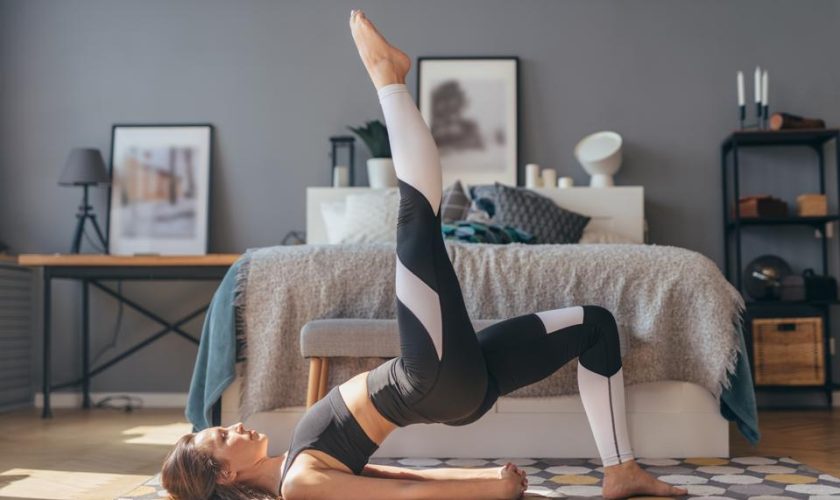
Before attempting to fix the issue, you need to establish whether your glutes are actually firing in the correct sequence. A simple single-leg bridge test will quickly reveal where your nervous system is routing tension.
Lie flat on your back with your knees bent and your feet flat on the floor, about hip-width apart. Extend your right leg straight out so it hovers in the air, leaving only your left foot planted. Place your left hand directly on your left buttock. Now, drive through your left heel to lift your hips toward the ceiling until your thigh aligns with your torso.
Pay close attention to where you feel the initial strain:
-
If the primary sensation is an intense cramp or tight pulling in the back of your left thigh, your hamstrings have taken over.
-
If you feel an uncomfortable arching or pinching sensation across your lower back, your lumbar spine is hyperextending to fake hip extension.
-
If you feel a solid, firm contraction across the meat of your buttock with zero strain in your back, your motor recruitment pattern is working properly.
If either your hamstring or lower back fired first, your brain has lost direct neuromuscular control over that hip extensor.
Step 1: Release the Front to Wake Up the Back
You cannot successfully activate a muscle if its opposing partner refuses to yield. Trying to strengthen your glutes without first restoring length to your hip flexors is like pressing the gas pedal while holding down the emergency brake.
To unlock the front of your hips, perform a targeted half-kneeling hip flexor mobilization. Kneel on a soft mat on your right knee, with your left foot flat in front of you at a ninety-degree angle. Most people make the mistake of lunging as far forward as possible, which merely arches the lumbar spine and misses the target tissue entirely.
Instead, stay completely tall. Actively tuck your pelvis underneath you—think of flattening your lower back and curling your tailbone forward into a posterior pelvic tilt. From that locked position, gently shift your entire torso forward just two or three inches until you feel a deep, distinct stretch in the front of your right hip and upper thigh. Hold this position for forty-five seconds while taking deep diaphragmatic breaths, then switch sides. Once the hip flexors yield their grip, the glutes finally have the mechanical clearance to contract.
Step 2: Targeted Re-Activation Drills
Once the hip flexors are relaxed, your next objective is to rebuild the neural pathway between your motor cortex and your gluteal fibers using controlled, low-velocity movements.
The Iso-Hold Glute Bridge with Tactile Feedback
Lie on your back with your knees bent and feet planted flat, keeping your toes pointing straight ahead. Before lifting your hips, brace your abdominal wall as if preparing to take a punch. Drive through your heels, lift your hips until your pelvis forms a straight line from your knees to your shoulders, and aggressively squeeze your glutes at the top.
Tap your glutes with your fingertips. Physical touch provides tactile biofeedback, helping your brain locate and recruit the specific muscle fibers you are trying to target. Hold the peak contraction for a full five seconds before lowering down under control. Complete two sets of eight repetitions, focusing entirely on contraction quality over speed.
Side-Lying Clamshells for Hip Stability
The gluteus medius sits on the outer edge of your hip and is responsible for stabilizing your pelvis when you walk, run, or climb stairs. When it falls asleep, your knees tend to collapse inward, creating chronic knee and foot strain.
Lie on your side with your hips and knees bent at roughly forty-five degrees, keeping your feet glued together. Roll your top hip slightly forward to ensure you do not compensate with your lower back. Keeping your heels touching, raise your top knee as high as you can without letting your pelvis rock backward. Pause for two seconds at the top, feeling the burn on the outside of your upper hip, and lower slowly. Perform fifteen controlled repetitions per side.
Integrating Movement into the Workday
Rebuilding motor control does not require hours of dedicated gym time; it requires consistent, low-level interruption of static postures throughout the working day.
First, adjust your office chair so your hips sit slightly higher than your knees. When your knees sit higher than your hip sockets, anterior hip compression increases dramatically, accelerating reciprocal inhibition.
Second, turn standing up into a micro-exercise. Instead of folding forward and using your lower back and quads to push yourself up, slide your feet beneath you, hinge forward at the hips while keeping your spine neutral, and drive forcefully through your heels. Squeeze your glutes firmly for two seconds once you reach a standing position. Doing this every time you get up for water or a phone call translates into dozens of daily neuromuscular rehearsals.
Fixing glute amnesia comes down to breaking up long stretches of immobility and re-establishing intentional neural connections. By systematically releasing your hip flexors, cueing the glutes with deliberate activation exercises, and standing with conscious intent, you can eliminate midday back stiffness and restore natural, pain-free movement.
Meta Title: How to Fix Glute Amnesia: The Desk Worker’s Guide
Meta Description: Learn how prolonged sitting causes “dead butt syndrome,” take a 30-second self-test, and follow simple mobility exercises to reactivate dormant glutes.